|
|
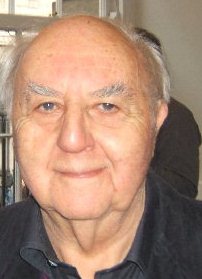
RONNIE WOLFE R.I.P.
CO CREATOR AND WRITER OF
ON THE BUSES
Ronald Wolfe, born 8 August 1922;
Died 18 December 2011
It
is with great sadness that I announce Ronnie Wolfe has passed away. We offer our sincere condolences to Rose and the family.
He brought laughter to young and old alike, and will be sadly missed. In Ronnie Chesney's words " it is the
end of an era." R.I.P.
bbc news magazine article
Some of the
best TV and radio comedy has been written by duos and Ronald Wolfe together with his partner Ronald Chesney
produced a string of hits. Wolfe first worked with Chesney on the BBC Radio programme Entertaining Archie which featured the
unusual concept of a ventriloquist act on radio. The show later transferred to ITV. In 1961 the pair created The Rag Trade,
a BBC TV sitcom which detailed the ongoing battles at a dress making company between the union, led by the strident Paddy,
played by Miriam Karlin, and Peter Jones and Reg Varney as the beleaguered management. Varney was to return as the star of
the pair's most successful creation, On the Buses, which again featured workplace conflict, this time between the bus
crew and Inspector Blake at Luxton and District. The series ran for four years, attracted audiences of more than 20 million
and produced three feature film spin-offs.
Local News
item about the passing of Ronnie Wolfe. THe photo shows him next to his cousin WARREN MITCHELL who was famous
for playing Alf Garnett CLICK HERE
|
|
|
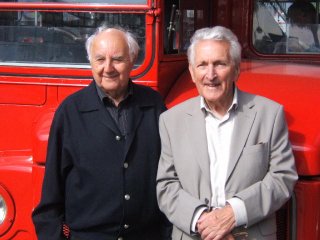
| Ronnie Wolfe and Ronald Chesney 2008 |
|
| Copywrite ON THE BUSES fanclub |
Uncle Ronnie to many of us was a greatly Loved and highly valued member of our Family.
We all took
great comfort with his natural charm and wonderful wit, we have lost such a Lovely and much cherished Husband, Dad, Grandpa
and Great Uncle.
Ronnie was of course known to his dazzling array of Friends too but it was the World who knew Ronnie
as the man (who along with Ronnie Chesney) Created some of the best comedy characters in history with infamous catchphrases.
Uncle Ronnie served as an in InSpiration to us all, both as a Family member and Friend and a Comedy Creator.
He made
the World laugh and that's what they will Love him for.
He touched those of us who were his Friends and Family with
his Heart.
We Love you Uncle Ronnie.
Richard Bennett/KingRichard76
Above The 2 Ron's at our 2008
ON THE BUSES fanclub event
|
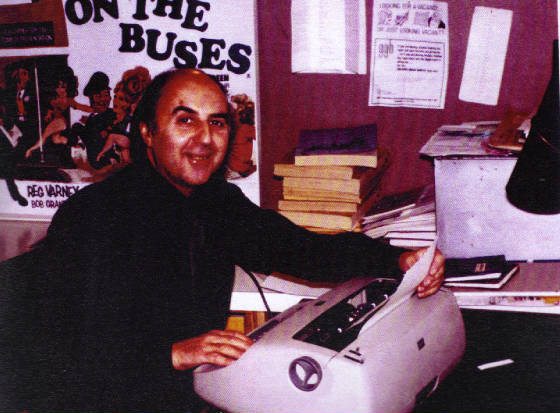
Ronnie working on the 'MUTINY ON THE BUSES script
|
RONALD WOLFE As a comedy writer, I am best known for the classic TV sitcoms The Rag Trade and
On the Buses, but I have also devised and written other sitcoms, and written extensively for films, stage and radio. I now
work as a public and after-dinner speaker and visiting lecturer. In
my work as Visiting Lecturer, I have been invited to speak and take Seminars and Workshops at The City University, London;
the London Department of the New York University, the University of Barcelona, as well as at many other leading universities
at home and abroad. Also at various institutes of learning which have departments of Drama, Film, TV, Radio and Media Studies.
As a Public and After-Dinner speaker, I have many amusing anecdotes
and stories about the host of stars and performers I have written for and worked with, and in addition, I have been asked
to be a member of the Sitcom Jury at national and international TV Festivals, and to sit on Comedy Show Panels. Details of all this, and more, can be found in my book, Writing Comedy, a new,
updated third edition of which was published
in March 2003 by Robert Hale Ltd. Visit the web site www.ronaldwolfe.com Right now, the work
I am concentrating on is mainly as a Tutor / Lecturer, giving seminars and workshops at departments of Drama, Film and Visual
Arts at universities and colleges, and at other institutes of learning teaching Media Studies. I am also very active as
a public and after-dinner speaker. My public speaking performances could, I suppose, be affectionately characterised as “Confessions of a Sitcom Writer” as they contain
lots of amusing anecdotes and experiences about the many famous people I have known and worked with over many years. Feedback from audiences
shows that they especially love to hear the amusing stories about what the stars are really like and what goes on behind the
scenes of the various shows. Some of the performers I have worked with are: | Barbara
Windsor | | Gillian Taylforth | | Ronnie Corbett | | Sheila
Hancock | | Sid James | | Thora Hird | | Kenneth
Williams | | Beryl Reid | | Benny Hill | | Tony Hancock | | Marty
Feldman | | Carla Lane | | Dick Emery | | Warren Mitchell | | June
Whitfield | | Frank Muir | | Denis Norden | | Reg Varney | | Jack
Dee | | John Inman | | Rula Lenska | | Tony Robinson | | Miriam
Karlin | | Peter Jones |
and of course all of the cast from On The Buses. ON
THE BUSES - This section is dedicated to the memory of my friend Simon who was in the process of writing an ON
THE BUSES book but sadly died at far to young an age before he could complete it. Here is part on an interview with
Ronald Wolfe I have been a comedy scriptwriter
for most of my working life, startingin BBC radio, writing sketches, continuity, etc. etc. My biggest break was meeting Beryl
Reid. She was brilliant, but badly needed a scriptwriter. I was Beryl’s scriptwriter for about 10 years, and wrote all
her scripts, from panto to intimate revue. When Beryl joined the top radio show, Educating Archie (originally createdand written
by Eric Sykes), I was asked to be part of the writing team, and went on to become head writer. Ronald Chesney – then
a performer – had a regular spot in Educating Archie, playing the harmonica. That is how we first met. I was one of
the writers; he was a performer. The cast of Educating Archie was star-studded, and included such names as Tony Hancock, Max
Bygraves, Benny Hill, Harry Secombe and Warren Mitchell. We
also did a tour of Australia – Chesney performing, playing his harmonica. I was writing a series for ABC called Archie
in Australia. The show was extended, we needed many more scripts, and I think that is how we got together. Chesney helped
me with the writing. When we got back to the UK, we
wrote a radio series for Sid James; then we had an idea about a dressmaking factory – about the workers and the Boss’s
problems.We took it first to one of the independent TV companies. It came back with a letter saying – “Many of
the British workers work in a factory; the last thing they want to do when they come home and switch on the TV, is to watch
a show about people in a factory”. Then we had a stroke of luck. Frank Muir and Denis Norden were appointed Comedy Advisors
to the BBC. We took our show – now called The Rag Trade – to them, and it was immediately commissioned. It became
a big hit. After The Rag Trade, we were asked to rewrite
a comedy play that Thora Hird and Freddie Frinton were going to do at Blackpool for the summer season. The play was most successful.
We thought that Thora and Freddie were a great team, and would be just right for a sitcom on television. We offered it first
to the BBC, with the title Meet the Wife. Actually the BBC were not that thrilled about the show, but figured they owed us
something after the unbelievable success of The Rag Trade. Rather
reluctantly the BBC commissioned a pilot show. It was transmitted, and got the highest rating of all time. We then did 39
episodes. . After The Rag Trade and Meet the Wife, we figured that - for want of a better phrase – “working-class
comedy” was something we seemed to be good at. Like most things, the idea for On The Buses seemed very easy, once we
had thought it out. We knew that we wanted to do something with Reg Varney because he was so very good in The Rag Trade. I
recall that we spent a lot of time deciding what job Reg would have. We felt he should be in some sort of uniform –
but what? Eventually we decided that he should be a bus driver. We then realised that the uniform told us so much about the
character. He would be about 40 years old, but still only a driver. Not very ambitious, easy-going sort of chap, reasonably
happy, enjoys his job, etc.We wrote a pilot script and several storylines, and sent them to the BBC. Back came the reply from
Michael Mills, who was then Head of Comedy. “Once you’ve done jokes about oil on the garage floor, and buses running
late, what is there?” That was the gist of the letter. Obviously Michael Mills didn’t like it.
|
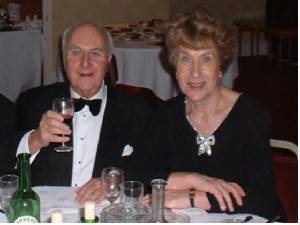
Ronnie and Rose Wolfe
Ronald Wolfe was born in London. During World War
II he worked as a Radio Engineer. After that he began working for the BBC, where in the early 1950's he was to meet Ronald
Chesney, writing The Rag Trade together they then wrote Meet The Wife starring THORA HIRD. Then along came ON THE BUSES.
He has wrote for summer shows, pantomimes etc for such performers as Beryl Reid and Ken Dodd and Tommy Steele in Cinderella.
Ronald Wolfe is married with two daughters and lives in London In his own words "As a comedy
writer, I am best known for the classic TV sitcoms The Rag Trade and On the Buses, but I have also devised and written other
sitcoms, and written extensively for films, stage and radio. I now work as a public and after-dinner speaker and visiting
lecturer. In my work as Visiting Lecturer,
I have been invited to speak and take Seminars and Workshops at The City University, London; the London Department of the
New York University, the University of Barcelona, as well as at many other leading universities at home and abroad. Also at
various institutes of learning which have departments of Drama, Film, TV, Radio and Media Studies. As a Public and After-Dinner speaker, I have many amusing
anecdotes and stories about the host of stars and performers I have written for and worked with, and in addition, I have been
asked to be a member of the Sitcom Jury at national and international TV Festivals, and to sit on Comedy Show Panels. Details of all this, and more, can be found
in my book, Writing Comedy, a new, updated third edition of which was published in March 2003 by Robert Hale Ltd. Right now, the work I am concentrating on is mainly as
a Tutor / Lecturer, giving seminars and workshops at departments of Drama, Film and Visual Arts at universities and colleges,
and at other institutes of learning teaching Media Studies. I am also very active as a public and after-dinner speaker. My public speaking performances could, I suppose,
be affectionately characterised as "Confessions of a Sitcom Writer" as they contain lots of amusing anecdotes and
experiences about the many famous people I have known and worked with over many years. Feedback from audiences shows that they especially love to hear
the amusing stories about what the stars are really like and what goes on behind the scenes of the various shows. Some of the performers I have
worked with are:
Barbara indsor, Gillian Taylforth, Sheila Hancock. Ronnie Corbett, Thora Hird, Kenneth Williams
Sid James, Beryl Reid, Benny Hill, Tony Hancock, Thora Hird, Marty Feldman, Carla Lane
Dick Emery, Warren Mitchell,
June Whitfield, Frank Mui, Denis Norden, Reg Varney
Jack Dee, John Inman, Rula Le, Tony Robinson to name but a
few.
and of course all of the cast from On The Buses. Career details as a writer Wild, Wild Women UK 1968
On The Buses UK 1969
The Other Reg Varney UK 1970
Romany Jones
UK 1972 Lottsa Luck USA 1973
Don't Drink The Water UK 1974
Yus My Dear UK 1976
The Boys And Mrs B UK 1977
The Rag Trade UK 1977
Watch This Space UK 1980
Take A Letter, Mr Jones... UK 1981
'Allo 'Allo! UK 1982
The Rag Trade
2004 (South Africa)
|
Then we had another stroke of luck. Frank Muir, who had been
one of the Comedy Advisors at the BBC, had recently left and was now Head of Comedy at London Weekend Television, one of the
newer independent companies. It was late on a Friday afternoon when we went to see Frank Muir with the On The Buses idea.
He quickly read the script, then disappeared for a quick word with Cyril Bennett, Head of LWT. He came back and said “We’re
in business! I like the idea, so does Cyril”. And right away he commissioned a series. I’m afraid that’s
the way the game goes. The On The Buses idea, which was rejected by the BBC, was commissioned by London Weekend Television. It ran for seventy-five episodes – three full-length films,
and a stage version that ran for two years in Canada. Once the show was commissioned, the next problem was casting. Reg
Varney was our No.1 choice for Stan Butler, the driver. Doris Hare had always been our choice for Stan’s mum. Unfortunately,
Doris was not available to do our first series; she was in Mexico with her husband at some academic conference. Her husband
was a Professor of Genetics. Cicely Courtneidge was booked to play Mum, and when Doris came back she took over. Strangely
enough, very few viewers seemed to notice the difference. Michael
Robbins was booked to play Arthur. That was a stroke of luck. Some of us were watching Michael in a Harry Worth show. Michael
only had a small cameo part, but he was magnificent – just right for us. Our first choice to play The Inspector was Dudley Foster. He had been sent a script, and we were
a bit surprised not to hear back from him. We then rang his Agent, and were rather shocked to hear that Dudley Foster had
committed suicide. (We never did find out whether or not it was before reading the script!). Time was then running short. We were getting near to our recording date. Then Stuart Allen,
our director, had a good idea. Stuart was directing a play, Mrs. Wilson’s Diary, at Stratford East Theatre. One of the
actors was Stephen Lewis, who was playing the part of a police inspector. Stuart thought that Stephen would be good as the
Bus Inspector – and he was. Bob Grant was in the same show, and he was booked to play Stan’s conductor. The hardest part to cast was Olive – Stan’s sister.
It is very difficult to find young actresses to play unattractive parts. Then we thought of Anna Karen, who was in one of
our other shows at the BBC. Anna desperately needed work, and with the aid of a wig, glasses and padding, she was playing
the part of a washed-out waitress. We arranged for Anna to see our director, and we were waiting for her at Reception. Then
Anna (being a woman), glided in dressed to kill, beautifully made up with false eye-lashes, liner, mascara, the lot! We knew
that she’d never get the part looking like that, so we dragged her out to our car, pushed her into the back, and told
her to get rid of all the make-up. Now, when Anna is
asked how she got the part, she says “The writers pushed me into the back of the car and told me to take everything
off!” Reg Varney was always our first choice
as Stan Butler. When we presented the format to Frank Muir, we put Reg down as our second choice. We had found from past experience
that TV executives treat a list of names somewhat like choosing from a wine list. They’re a bit suspicious of the first,
and usually plump for the second. Somehow they feel that it is ‘safer’ and not too expensive. (Note: There is much more to writing scripts than putting words on paper!) What was Reg
like to work with? Well, at the first read-through, Reg was not usually very good. He would take the script home, work on
it, make sure he really understood it. He learnt not just his part, but everybody else’s part. By the end of the rehearsal
week Reg was brilliant. Although Reg was the star of the show, he had about every fourth line in the script. But he never
resented others getting the laugh lines. 7.The shows
were recorded at the London Weekend Television Studios, at Stonebridge Park, Wembley. Rehearsals were at the London Weekend
office block, nearby on the North Circular Road. We wanted to use the Red Routemaster buses of London Transport, but the London
Transport bosses were very worried about this. They thought there would be problems with the Unions, etc. etc. The TV series
used the Eastern National buses from their depot at Wood Green. Actually,
when the show became a big success, London Transport changed their minds, and the three feature films of the series used London
Transport red buses, and also their training grounds in Chiswick. Our
writing routine was very simple. We had three places to work; my house, Chesney’s house, and the London Weekend studios.
We wrote a few pages every day. On recording days, we’d be in an office at the studios. The cast would be rehearsing
one episode whilst we would be writing one of the future episodes. We would be on hand if there were any problems.9. The first
series was in black-and-white. I don’t recall any problems with the advent of colour TV. On The Buses – the Movie, was Hammer Films’ second TV comedy spin-off. I think
the first one was The Navy Lark. This was fairly successful, made money, and that is why Hammer were interested in doing The
Buses films. Women drivers were a topic at the time, which is why we used the idea for the film. Buses was a TV sitcom that
lent itself to a full-length film. Writing the TV series was very restrictive. The budget to make the film was a big problem.
It was going to be financed by London Weekend, but they backed out at the last minute. Their thinking was – ‘why
should anybody pay to see the film when they can watch the show on TV for nothing?’ The writers then went to Bernard Delfont. He agreed to finance the film, but the budget
was limited to £100,000. (one hundred-thousand pounds sterling). The success of the film was that it was different from
the TV series; lots of shots of buses on the road, etc. Also, it was very, very funny, and the writers did not use any material
that had been seen on TV. Having most of the cast in
uniform was a great help. The shows did not look dated. The budget for the second film was a bit bigger, but not much.
The idea of using Windsor Safari Park probably came from Roy Skeggs, Hammer’s Production Manager. Also, the guys who
ran the Safari Park – the Smart Brothers were all members of the Variety Club. The important thing was that we
were able to use the Safari Park for nothing, provided the Park got plenty of publicity. Bob Grant did have many different girl-friends. His part in the show was really an extension
of his basic character. Bob was very reliable to work with, but surprisingly, the success of the show did make him rather
big-headed. He lived way beyond his income, and married Kim, a showgirl in a huge blaze of publicity. Thousands of fans lined the wedding route to Caxton Hall.In later years he must have had
some mental problems. I think he tried to commit suicide two or three times, so I wasn’t terribly surprised when I heard
the news that he had. Holiday on the Buses was
filmed mainly at Pontins Holiday Camp at Prestatyn. Again, we were given all the facilities for nothing, provided we gave
Pontins plenty of publicity. Blakey’s foot. A
few days before the start of filming, Stephen fell and broke his ankle whilst doing some DIY job in his house. We wrote the
broken ankle into the script. In the film, I think it happened when he fell from a bus. The important thing was, it fitted
into the script quite well and there were no problems. Chesney
and I were under contract to NBC studios in Los Angeles, to work inthe American version of On The Buses. London Weekend Television
wanted more shows, and so they used other writers. We
are not sure why Michael Robbins left the show. We were not in the UK at he time. Michael Robbins was a very good actor –
much in demand. But the general public only knew him as Arthur. Michael had cancer for some time before he died. Michael and
his wife, Hal Dyer, were staunch Catholics, and I think they found their religion of great help and solace towards the
end of his life. With the writers working in Los Angeles,
and lack of proper contracts from London Weekend Television, the show more-or-less fell apart. The cast eventually all got
better offers. Don’t Drink the Water. Originally
this was written for Thora Hird, co-starring with Stephen Lewis. Thora, however, got involved in another show, and Don’t
Drink the Water went ahead with Stephen Lewis and Pat Coombs. (We are trying to find a tape of this show). The success of On The Buses is due to strong, believable storylines. Also, it was very
funny.
|
|

